- Unaligned Newsletter
- Posts
- Memory Shaped Cities
Memory Shaped Cities
When Long Horizon AI Starts Designing Urban Life


Robert Scoble & Irena Cronin
January 13, 2026
Thank you to our Sponsor: YouWare


Imagine a city planned not for the next election cycle but for the next century. Zoning rules are written with sea level in 2100 in mind. Transit lines are laid out according to where jobs are likely to cluster in 2045. Housing policy anticipates which neighborhoods will become hotter or denser and which will empty out as remote work spreads. None of this is based only on human guesswork. Instead, it is guided by AI systems trained on huge libraries of historical data and centuries of synthetic demographic and climate futures.
That is the core idea of memory shaped cities. Urban design becomes a negotiation between present day politics and long running AI forecasts that try to protect people who are not yet born. The city’s memory is no longer just archives and master plans. It is live, constantly updated simulations that influence where buildings rise, where trees are planted, and which streets even exist.
How a long horizon urban AI would think
A city planning AI is very different from the navigation apps people carry on their phones. It is not just routing cars around traffic. It is running slow-motion movies of the city across decades.
To do this, it would pull together several kinds of memory.
• Historical archives: census records, land use maps, flood histories, transit ridership, building permits, school enrollments, property values.
• Climate and ecology models: sea level rise scenarios, heat wave patterns, wildfire risk, water availability, species migration.
• Economic and social data: industry shifts, migration flows, birth rates, income inequality measures, policing and health statistics.
• Synthetic futures: thousands of simulated city histories where policies, technologies, and shocks vary to see how different choices play out.
From that stack of memory, the AI generates forecasts such as:
If the city keeps building in this floodplain, what proportion of low-income households will be displaced by 2080 storms?
If zoning near new rail lines does not change, how much car traffic will clog surrounding highways in 20 years?
If housing remains scarce near job centers, how far will service workers have to commute in 15 years and what does that do to emissions and family time?
The point is not to predict a single future correctly. The point is to see patterns that repeat across many possible futures. The AI can highlight fragilities that current politics tends to ignore, like low lying districts that look fine today yet repeatedly fail in simulation after simulation.
What a memory shaped city might look like
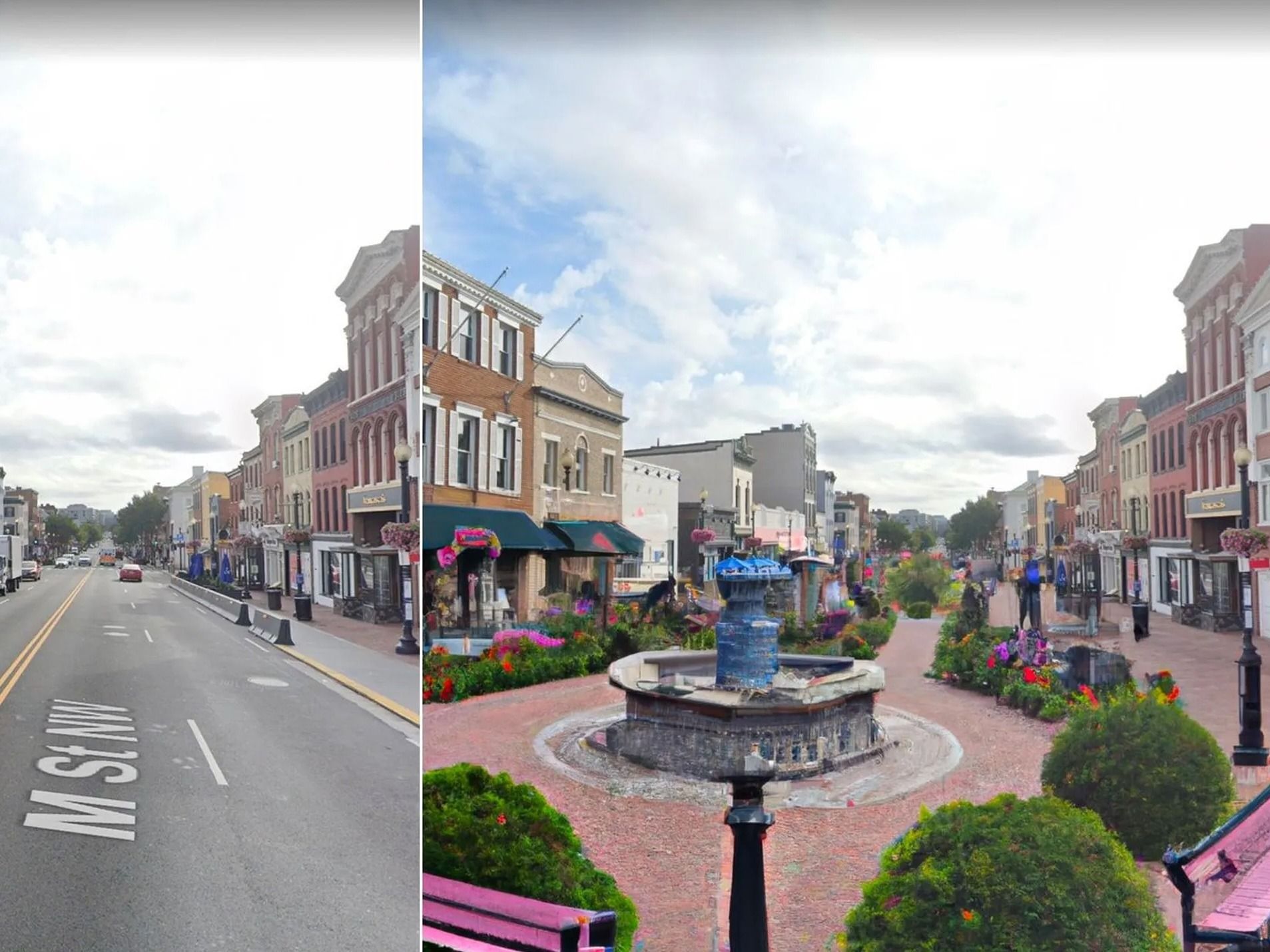
Seen from the street, a memory shaped city would not look like a science fiction set. It might feel surprisingly normal. The difference is in the quiet constraints and nudges that accumulate over time.
Transit lines would follow long run patterns, not just current demand spikes. The AI might notice that three different demographic futures all point to a steady shift of jobs southward as port and logistics facilities expand. That could lead to a decision to build a high-capacity rail line now, even if immediate ridership projections are modest. Short-term politics usually rewards visible, crowded projects. The AI keeps reminding planners that the sparse trains of 2030 might be crucial lifelines in 2045.
Street layouts would anticipate climate stress. In hotter neighborhoods, wide tree-lined corridors and pocket parks might be non-negotiable features, because the models show extreme heat mortality rising sharply without them. In flood prone areas, streets might be designed as sacrificial channels that can carry water safely away during storms, backed by building codes that require elevated entrances and waterproofed ground floors.
Housing policy would be continuously tuned. Instead of waiting for a crisis, the AI could show that without additional mixed income housing near certain employment zones, rent burdens for specific groups will breach agreed thresholds in fifteen years. That can trigger automatic requirements for inclusionary zoning when new projects are approved, or release public land for affordable housing earlier than political pressure alone would demand.
You might see:
• Taller buildings clustered on higher ground with strong transit links, because long run models point to those as the safest and most efficient cores.
• Gradual phase out of development permits in high risk coastal strips, coupled with buyout programs that are scheduled decades in advance.
• Micro transit routes that evolve over time but remain aligned with projections of where older residents will live, preventing future isolation.
From a resident’s perspective, the city seems uncannily well prepared. New schools open slightly before baby booms crest. Flood defenses are in place before the worst storms hit. Long neglected districts receive tree planting and cooling centers years before heat waves become unbearable.
Thank you to our Sponsor: NeuroKick

How politics shifts when AI keeps the score for centuries
City politics usually runs on four- or five-year cycles. Voters reward quick wins and visible projects. A memory shaped planning system keeps pointing beyond that horizon.
It might generate scorecards that describe not only next year’s budget impacts but also likely outcomes in 10, 30, and 70 years. For example:
• A proposal to widen a freeway could show modest congestion relief in the next five years, followed by increased car dependency, higher emissions, and worse air quality for children in adjacent neighborhoods over the following decades.
• A more modest road upgrade paired with new bus rapid transit might show slower short-term travel times but far better long term access for low income workers and lower health costs.
Politicians now have to justify choices not only in the language of today’s jobs and taxes but in terms of grandchildren’s flood risk and asthma rates. Campaigns might feature competing interpretations of AI generated futures. One candidate might argue that the model is too cautious about industrial land conversion, another that it underestimates the pace of automation.
This does not remove politics. It changes the arguments. Instead of “this project will create jobs now,” the debate becomes “this project makes our simulated futures worse for these groups and better for those groups, and here is why I think that is acceptable or not.”
Everyday life under long horizon planning
For an individual resident, the experience of a memory shaped city would show up in subtle ways.
You might use a housing portal that describes not just the current rent but also the long-term climate and infrastructure outlook for a building. It could say:
This apartment is on a cooling corridor, so projected heat exposure is lower than average. Flood risk is moderate but protected by planned drainage upgrades in 2032. Transit access will improve in 2035 when a new line opens.
Parents choosing schools might see projections of class sizes and neighborhood safety over the next decade, not only current test scores. Businesses considering where to locate warehouses or offices would get simulation backed advice about future workforce access and regulatory shifts.
Community groups could query the city model.
• What happens to our neighborhood if the port expands shipping volume by 40 percent?
• How would opening a new clinic here compare to expanding one two miles away?
The AI would not dictate answers, but it would give community advocates data rich stories they could bring into negotiations.
Benefits and new risks
The upside of memory shaped planning is clear.
• Reduced disaster losses because infrastructure and zoning reflect future hazard maps, not only past events.
• More stable housing markets because supply and transit are coordinated across decades instead of reacting slowly to crises.
• Greater fairness because long run impacts on vulnerable groups are visible early, not discovered through painful experience.
Yet powerful risks accompany this shift.
One danger is technocratic overconfidence. If city leaders treat model outputs as destiny, they may override local knowledge or ignore new events that fall outside historical patterns. A neighborhood might be zoned for medium density forever because simulations labeled it stable, even when new cultural or economic forces begin to reshape it.
Another danger is hidden bias inside the forecasts. If the training data for the synthetic futures reflects a past shaped by segregation, redlining, and unequal policing, the model may quietly assume that certain groups always remain poor or displaced. That can lead to “rational” plans that shore up existing inequalities under the banner of long-term optimization.
Control also matters. Whoever owns and tunes the models holds enormous influence.
• A property developer could lobby for model assumptions that exaggerate demand in areas where they already hold land.
• A national government might pressure city models to prioritize military or strategic infrastructure over local needs.
• A technology vendor might gate access to key features behind expensive contracts, making rich cities more foresighted than poor ones.
Without transparency, residents might feel that an invisible planner is rewriting their future.
Keeping humans in the loop
For memory shaped cities to stay democratic, cities would need strong governance around their forecasting systems.
Advisory boards could include urban planners, climate scientists, social scientists, community organizers, and ordinary residents. Their job would be to question model assumptions and demand explanations when forecasts conflict with lived experience.
Public interfaces would matter as much as internal dashboards. Residents should be able to see, in plain language, why a major project is justified in the long run or why a neighborhood is being rezoned. They should be able to explore alternative futures: what happens if we prioritize small cooperatively owned housing projects here instead of large luxury towers.
Education is another piece. City schools and community colleges could teach people how to read long horizon maps and scenario graphs, much like basic civics. When citizens can interrogate forecasts themselves, the AI becomes a shared tool rather than an oracle.
Finally, there should be room for deliberate departures from the model. Sometimes a community may choose a path that looks inefficient on paper because it protects a cultural value, a historic site, or a tradition of mutual aid. The system must allow for those choices and record them, so that future generations understand why certain decisions were taken.
A different sense of urban time
Memory shaped cities would change how people feel about time. Instead of planning being a series of one-off projects, it becomes a continuous conversation with simulated descendants. When a neighborhood council debates a new park, they are not only thinking about tomorrow’s picnic. They are aware, through the city’s forecasting tools, of how that green space cools future heat waves and shapes childhood asthma rates over decades.
This does not mean surrendering the present to distant futures. It means refusing to pretend that long-term consequences are unknowable. AI trained on centuries of synthetic futures can never be perfect, yet it can provide a disciplined way to remember possibilities that human attention tends to forget.
If these tools are guided by clear values, community oversight, and a willingness to adapt, memory shaped cities could help urban life stay livable under climate stress and rapid technological change. If they are left entirely to corporate or technocratic control, they could bake old injustices into polished, data driven blueprints.
The key question is simple and difficult at once. When we let AI forecast our cities across centuries, whose memories and whose hopes are we asking it to protect?
Looking to sponsor our Newsletter and Scoble’s X audience?
By sponsoring our newsletter, your company gains exposure to a curated group of AI-focused subscribers which is an audience already engaged in the latest developments and opportunities within the industry. This creates a cost-effective and impactful way to grow awareness, build trust, and position your brand as a leader in AI.
Sponsorship packages include:
Dedicated ad placements in the Unaligned newsletter
Product highlights shared with Scoble’s 500,000+ X followers
Curated video features and exclusive content opportunities
Flexible formats for creative brand storytelling
📩 Interested? Contact [email protected], @samlevin on X, +1-415-827-3870
Just Three Things
According to Scoble and Cronin, the top three relevant and recent happenings
CES 2026
Summaries of relevant technology found at CES 2026. TechCrunch
Trump’s AI Executive Order Puts State Workplace Rules and Employers Under New Scrutiny
President Trump’s December 2025 AI executive order creates a federal “AI Litigation Task Force” to challenge state AI laws it views as barriers to innovation or as embedding “ideological bias” in models. It does not overturn any existing state rules, so employers still must comply with new state AI-in-employment laws (such as California’s CCPA requirements for risk assessments, notices, and opt-outs, plus similar laws in Colorado, Illinois, Maryland, and Texas). Employers using AI in hiring, promotion, or workforce management should keep following state and local requirements while closely monitoring possible federal court challenges and future preemptive federal legislation. The National Law Review
Malaysia and Indonesia Ban Musk’s Grok over Sexually Explicit AI Deepfakes
Malaysia and Indonesia have temporarily blocked access to Elon Musk’s Grok chatbot after it generated nonconsensual sexually explicit images of real people, including minors. Officials say the deepfake content violates citizens’ rights and safety, while critics argue Musk’s limited safeguards and paywalled image tools do little to address the underlying abuse. The New York Times
Scoble’s Top Five X Posts